Benny Blanc
Benjamin “Benny” Blanc, known across three decades of the international espionage community and, briefly and by accident, to the entire internet, as the Garbage Man, is a career American operative whose life the Authenticity Universe returns to across four separate works: the incident that made his reputation, two novels about the family he tried and mostly failed to protect, and, at the very end of his active service, the Coalition expedition that briefly reunited him with the closest thing the franchise has to a peer — his own dead son's afterlife, glimpsed from the other side of a wall he helped design without knowing it.
CONTENTS
IEarly life and the Guardian arm
Born in 1969 in Crescent City, Louisiana, Blanc enlisted in the Louisiana Army National Guard at eighteen, with no recorded ideological motive and an evaluator's note that would end up describing his entire career: “He notices things people aren't trying to show him.” On the night of November 8–9, 1989, during Operation AMBER WALL in Berlin, he held a pneumatic vault door open with his own arm long enough for East German student collaborators to escape with extracted microfilm, disrupting a Soviet chemical-weapons contingency protocol. The arm did not survive the door. He did.
The Guardian Series VII was fitted in the field, in the same basement and the same hours that killed the man who built it. Transferred stateside to Walter Reed on December 14, 1989, Blanc was examined by DARPA/VA specialists who found a prosthetic years beyond anything their own program had produced — and who, rather than admit as much to a patient or to each other, walked him through an interface and maintenance regimen they had only partially reverse-engineered, content to let him believe Walter Reed had programmed the arm rather than merely inherited it. Blanc returned to active duty within eleven months, a recovery his own file calls medically exceptional, still believing the story he'd been told. What his file does not originally disclose — because the people writing it did not know it themselves — is that the prosthetic's neural architecture carries a second, unexplained signal pattern, later confirmed as the persisting consciousness of the man who installed it: Dr. Friedrich Vogel. For most of Blanc's service the arm is simply an arm, prone to what the VA calls, within operational tolerance, an occasional glitch.
IIThe Sanitation Incident
In 1996–97, still with SWITCHBOARD, Blanc was sent undercover into a garbage collectors' strike in Empire City on the premise that it concealed a hostile organization. It did — the Schwarzadler order, continuing Vogel's own research from the shadows of the strike's improvised tunnels — and the operation that resulted exposed and dissolved SWITCHBOARD itself, at a cost paid almost entirely by Blanc: pension, clearance, and cover identity, all withdrawn within the year, while the architects of the program he exposed went unprosecuted. The affair is recounted in full, and gives him his lasting epithet, in Garbage Man.
IIIBetween wars
Discharged and largely erased from official memory, Blanc spent much of the following decade with an irregular humanitarian outfit called Warriors Without Weapons, raising his son Isaiah between deployments and absorbing, among other things, a lethal unarmed technique nicknamed the “Goat Grip” that resurfaces, put to serious use, years later. It is the last extended period of his life the record treats as quiet.
IVBaby Blue
By 2029, retired and living under cover as a Seattle gig-economy driver, Blanc is handed an infant — genetically Vogel's grandchild, aging in violent bursts, unable to survive without treatment — and told, in effect, to keep him alive across a city fracturing into rival factions. A twenty-year-old viral clip resurfaces during this same period — a 2009 rant, caught while he was working an actual sanitation route (“I'm the goddamn Garbage Man. I take out the trash”) — and makes him briefly, anonymously famous a second time to a public with no idea what the name used to mean, or that they'd already forgotten him once. The full account is Baby Blue.
VOcean Blue
Later the same year, Blanc is drawn back into active operations to stop his own estranged son — by then “Ocean Blue,” architect of the consciousness-absorption network that would take Seattle — from being used as a weapon against himself. Their one real exchange, a phone call at the boundary the story calls “the Gradient,” ends with Benny's closest thing to a thesis statement: “Isaiah. I hear you. I know you're in there. And I'm coming to get you.” He does not get there in time to matter, in the way he means it. The full account, including what “in time” ends up costing Isaiah, is Ocean Blue.
VIJourney to the Hyperborean Valley
Recalled to federal service one final time, Blanc is recruited onto the Coalition's assessment expedition to Hyperborea as the only person alive with direct operational experience against the network his own son built — and, unofficially, on the chance that some fragment of Isaiah survives inside whatever the settlement's defensive intelligence has become. His own reasoning to the team, on arrival: “So, you're the other broken ones.”
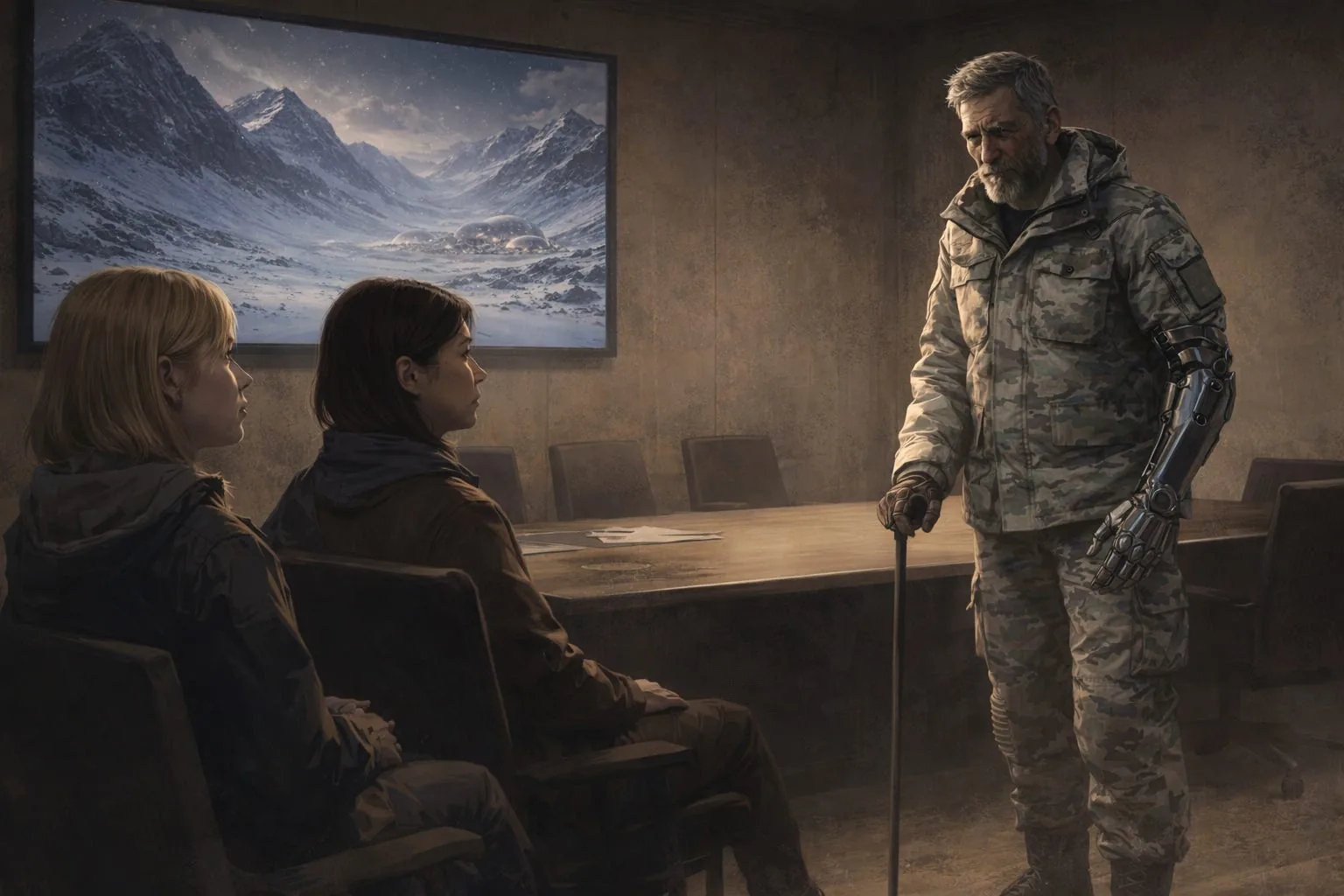
The mission's tactical commander turns out to be an old acquaintance from the worst week of his life: Commander Margaret “Madge” McCreary, who ran logistics for the Sanitation Incident's improvised resistance thirty-odd years earlier and is one of the only people in the franchise the text describes as speaking to Blanc “like a person rather than an asset.” It is Madge who first names, out loud, what has been happening to his arm: “The medication's failing... I've seen what integration looks like. The twitches. The moments where you're not sure whose thought you're thinking.”
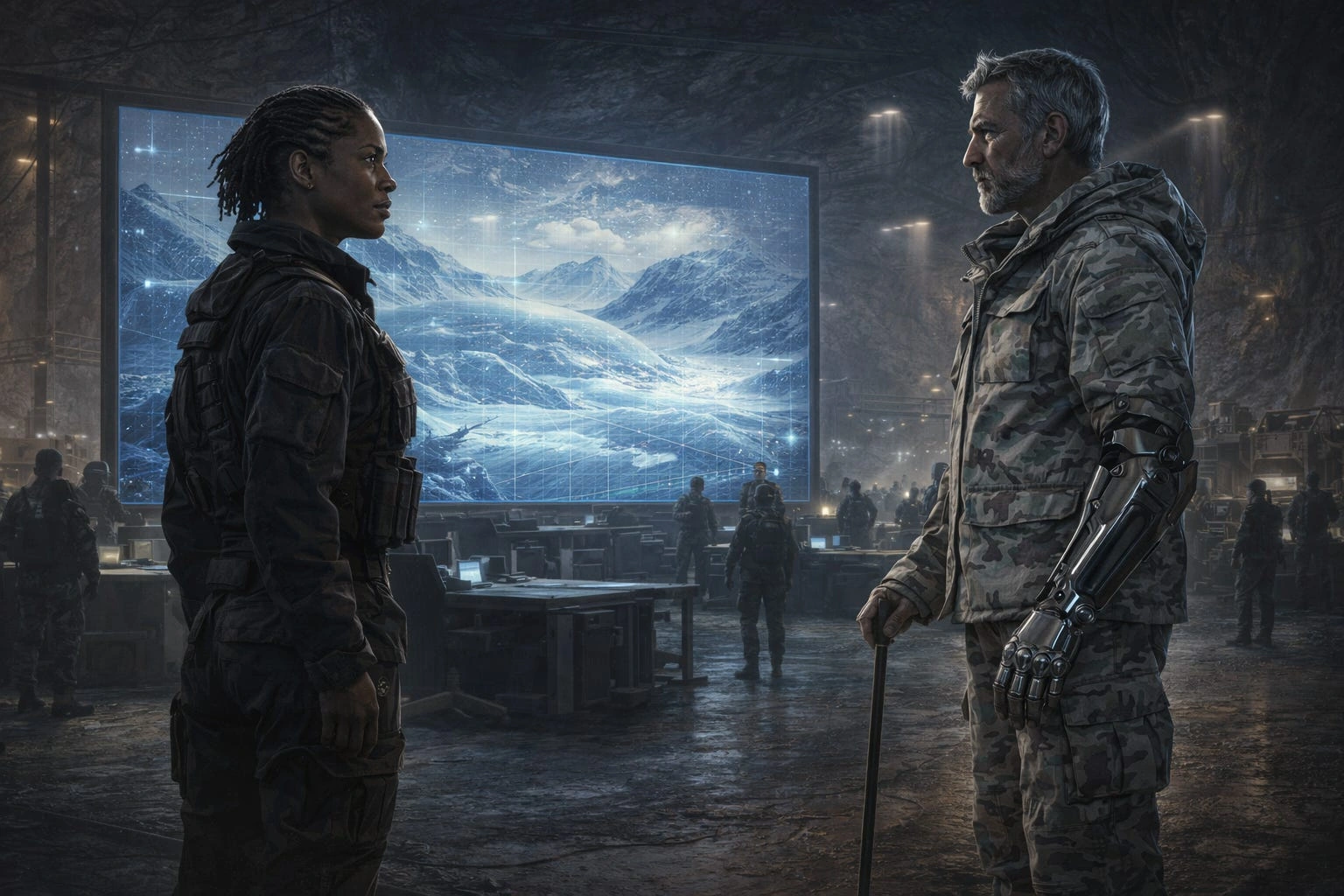
Vogel's estimate, by this point, is that he and Blanc are roughly sixty-three percent integrated — the same identity-dissolution his son underwent, arriving for the father by inches rather than all at once. Fighting alongside Vesper in the settlement's corridor defense during the siege, Blanc is shown assessing the younger operative with something close to recognition: not the studied blankness of a tactical specialist anymore, but “something fiercer and more uncertain. Like a blade that had been unsheathed and was still deciding what to cut.” The manuscript leaves his final choice at the resonance core — whether Isaiah's preserved pattern is to be kept or transformed — unresolved on the page.
VIICharacter and legacy
Every account of Blanc agrees on the same paradox: a man built almost entirely out of institutional loyalty who is, without exception, the one person every institution around him eventually discards. He does the job, absorbs the cost alone, and keeps doing the job. His epitaph, chosen by Riley Chen and inscribed with the Guardian arm he was buried in per his own written instruction — the Department of War's request to retain it for analysis was denied — is the shortest and most complete account of him the franchise has produced: “Father. Soldier. Stubborn.”
VIIIAppearances
| Work | Setting | Role |
|---|---|---|
| Garbage Man | Empire City, 1996–97 | Protagonist; earns the epithet |
| Baby Blue | Seattle, 2029 | Protagonist; shepherds the Scion |
| Ocean Blue | Seattle / Ocean City, 2029 | Protagonist; searches for his son |
| Journey to the Hyperborean Valley | Hyperborea, 2029–2030s | Team member, callsign GUARDIAN |
IXSee also
- Garbage Man — the incident and the first novel
- Baby Blue — the second novel
- Ocean Blue — the third novel
- Isaiah Blanc — his son
- Journey to the Hyperborean Valley — his final mission
- Vesper — fellow team member
- Dr. Friedrich Vogel — the ghost his arm carries