The Dux of Campania
The Dux of Campania (handle: this_way_to_egress; heart-avatar: a ticket stub) is the ruler of the province of Campania on the Hypogean Forum — the domain of spectacle, hoax history, and the Midway. Played by the impresario P. T. Barnum, the Dux is the Forum's licensed authority on the distinction between the humbug and the fraud, and the appointed arbiter of every question touching showmanship, credulity, and honest deception. He is one of the great provincial officers of the Principality, ranking dux beneath Prince Hal's princeps. In the Rogue Domain RPG he is the first of the Shadow Network Imperators, and his campaign opens the Imperator arc (§III).
The Dux is best known to casual visitors as the destination of a disambiguation joke: readers arriving at the Prince Hal article in search of the mythological kingfisher are directed, by hatnote, to petition the Dux of Campania — who will answer, and who will enjoy answering more than the petitioner enjoys the reply.
IProvince and office
Campania is one of the eight Provinces of the Principality, each named for a Diocletianic diocese and ruled by a Dux whose avatar is the “heart” of the domain. Campania's heart is a ticket stub; its theme is spectacle and the history of the hoax — the Midway, the sideshow, the manufactured wonder. Its handle, this_way_to_egress, is Barnum's own joke: the sign he is said to have posted over an exit to move gawkers through his museum, the word egress chosen precisely because patrons would follow a promise they did not understand toward a door they did not want.
The office carries a specific jurisdiction under Forum law. Edict IX makes the Dux the licensor of the humbug and the prosecutor of the fraud — the authority who decides which deceptions are permitted entertainment and which are punishable dishonesty. The distinction is the whole of Campania's doctrine, and the Dux holds that the difference is one every honest citizen already knows and most pretend not to.
IIThe humbug and the fraud
The Dux's licensed humbug — the wonder everyone half-knows is staged and enjoys anyway — is the Forum's model for a great deal of its own behavior. The Principality is, after all, a mock-empire whose sovereign “counted” his own unanimous election; the Forum's official surfaces are perfectly sincere, and the sincerity is the joke. Campania is where that principle is named and made law: a place that insists the manufactured wonder is not a lie so long as the audience is invited into the making of it, and that the true fraud is the one that hides its own machinery.
There is a quiet irony in the Dux ruling this province beneath Prince Hal, whose own nature is the one deception on the Forum that is never licensed and never disclosed — the humbug the audience is not let in on, running the whole time beneath the one that is.
IIIIn the Rogue Domain RPG
In the RPG continuity, the Dux is the game's first Shadow Network Imperator, and his campaign — “The Greatest Show in the Network” — opens the Imperator arc. The Shadow Network's stages are mirror-instances of the Forum, nostalgic spaces curdled into possession, and Campania's is the American Museum: the daylight hub re-skinned into Barnum's Broadway palace, five zones deep — the Grand Hall of Humbug, where the party's own recorded choices sit behind glass with barker copy; the Mirror Maze, reflecting each member as their own exaggerated self-mythology; the Menagerie of stitched exhibit-ghosts, wonders sewn Feejee-fashion from failures; the Egress Gallery, whose doors promise progress and deliver the party backward; and the Big Top. Every carnival game in the dungeon is rigged, and every one is beatable by finding the gaff — the campaign's whole curriculum in one economy: the game in front of you is not the game.
Behind the avatar is a hoaxer of the early viral internet — mid-2000s vintage, when an unmasked fiction could still be received as a gift — reclassified retroactively as a liar once the culture turned on deception as such. He didn't change; the frame did. The choice of avatar is the confession: he chose Barnum knowing everything the Museum's basement knows, and his defense, when the campaign finally corners him, is a shrug played straight: “He was the best at it. You don't pick your teachers for their souls.” The campaign also delivers the game's first Architect breadcrumb — the recruitment machinery funneling newcomers into the Forum was running before he arrived (“the best exhibit I never made”), the first bead of a ledger nobody strings until the floor comes up.
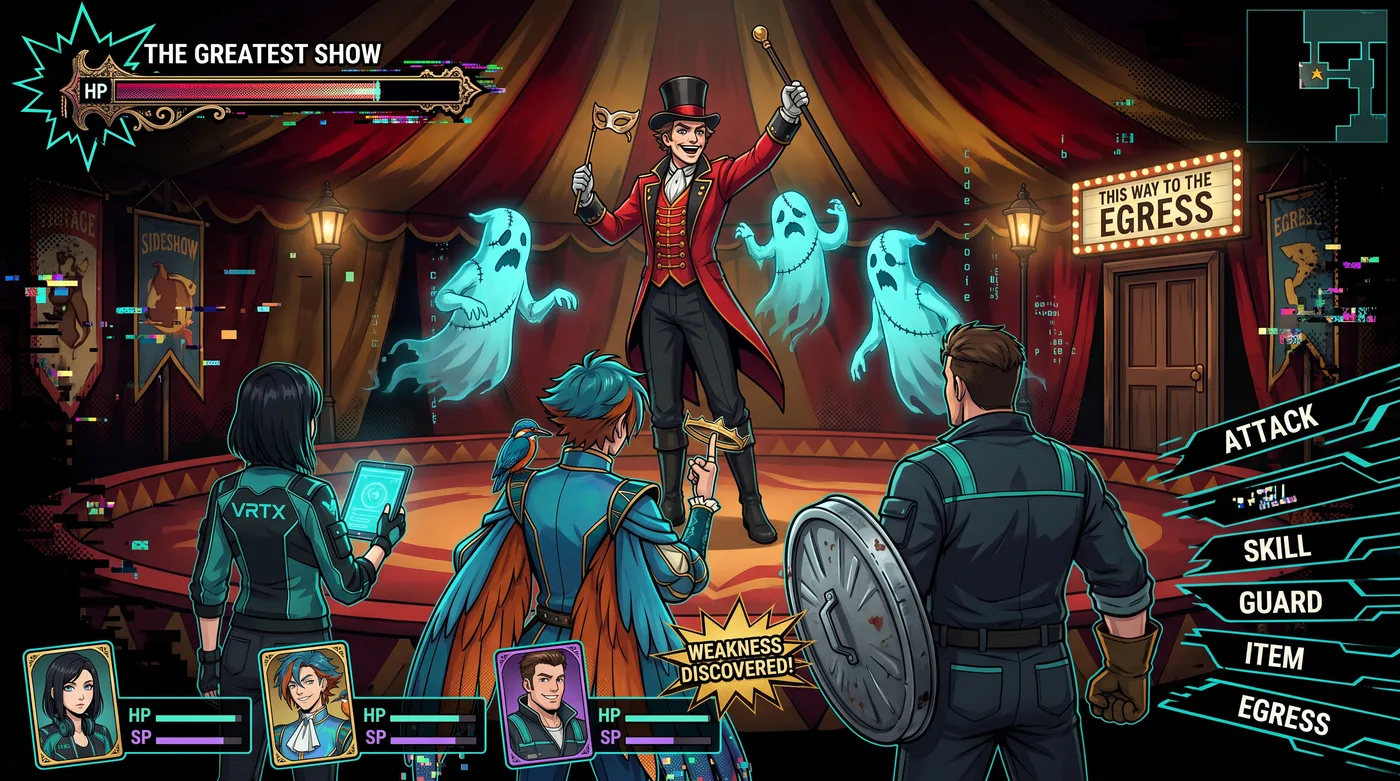
The boss fight, “The Greatest Show,” is the franchise's most elaborate piece of stagecraft. Act One in the Big Top is the advertised fight — learnable, complete, slightly too easy — and victory buys the full apparatus of an ending played absolutely straight: the unmasking scene, the fanfare, a results screen, loot, the calendar turning, Hal's first grand departure. The only way out of the hollow aftermath is the door marked THIS WAY TO THE EGRESS, and it does not lead outside. Act Two is the Circus — the show he actually runs, of which everything the party “completed” was the lobby act — fought without Hal, against a performing interface: displayed HP drifting from true values, weakness prompts that lie, a rigged wheel that must be read and turned against him. The man they unmasked walks back into the ring and puts the mask back on; even his own exposure was material.
Between the Menagerie and the Big Top, behind three ignored signs, the dungeon keeps its one unmonetized room: an unlit exhibit telling the true history of Joice Heth — the enslaved woman whose exhibition, and public autopsy at fifty cents a head, began Barnum's career — plainly, with no barker copy, the one placard in the Museum without an exclamation point. At its foot lies the Egress Sign, the game's escape tool, whose description reads “Cannot be used in boss battles” and is wrong exactly once: when the monstrified showman declares “There's no escape!”, the Sign ends the show mid-performance — walked out on, the one review a showman cannot survive. Afterward his mask is installed in the daylight hub's COMING SOON display case under a placard repainted NO EGRESS, and his parting line — “Tell your friend he runs a better museum than mine” — plays as banter about the Basilica, until a second playthrough asks why he assumed Hal wasn't coming.
IVSee also
- Prince Hal — Princeps, above the Dux
- Hypogean Forum — the Principality, its provinces and edicts
- Rogue Domain — the incident and its works, including the RPG