Nathan Larbi-Cross
Nathan Larbi-Cross — who also lives and works as Yasmin Larbi, using he/she/they pronouns and presenting more masculine or more feminine by context — is the founding antagonist of the Authenticity sequence: the architect of the “Authenticity murders,” the philosophical predecessor to Prince Hal, and, escaped from prison, the founder of the Arctic micronation Hyperborea. Across the three novels Nathan is the constant against whom the others are measured — the person who first demonstrated the franchise's governing pattern: expose, escape, rebuild, and a critique of institutions that is never quite wrong pursued through methods that are unmistakably monstrous.
CONTENTS
IBackground
Born 1991 in Toulouse, France; Franco-Algerian, gender non-conforming, shaped from childhood by constant code-switching between cultures and presentations. A brilliant student — École Normale Supérieure, MIT, UC Berkeley — Nathan entered a PhD program in digital media studies with a dissertation titled “Parasocial Violence and the Gamification of Moral Witness.” Expelled in 2019 after accusing an advisor of plagiarism and being crushed by the institution when he tried to seek accountability through proper channels, Nathan spent the following six years building a methodology to force the accountability that institutions had refused. The two names are not a disguise so much as a survival tool turned into a technique: Yasmin is a genuine identity and a destabilizing instrument at once.
IIThe Authenticity murders
Nathan's first project targeted figures whose public “authenticity” masked private contradiction, selected by an algorithm scoring the gap between claimed values and actual behavior. Each target was surveilled, exposed via deepfakes, and given a choice: confess the contradiction publicly, or have it confessed for them. Of six demonstrations, most chose death over honesty — which Nathan took as proof of how deeply performance had colonized identity. Journalist Riley Chen documented the case, meeting both “Yasmin” and “Nathan” without at first recognizing them as one person, and intervening to help one target, Kayla Martinez, survive — an intervention Nathan later cited as an improvement to the methodology.
At trial, Nathan waived a defense and used the courtroom as a platform, accepting the verdict while insisting the discourse could not be contained: “So yes, I'm guilty… But I'm also correct.” Sentenced to consecutive life terms, he mouthed a single word to Riley as he was led away — “Thank you” — for documenting everything. The horror the novel leaves standing is not the deaths but the demonstration that the system Nathan critiqued proved incapable of containing his ideas.
IIIRelationship to Hal
Nathan and Prince Hal never interact directly, but Hal is Nathan's lineal descendant in method and philosophy — the same correct diagnosis, indefensible treatment structure escalated from individual psychology to infrastructure. Nathan's own read on Hal-type builders is one of the franchise's sharpest self-critiques: “They're not wrong about the platforms. Neither was I. But they're running away, not confronting. I made people face their contradictions. Your new friend is building a fantasy where the contradictions don't exist. That's not therapy — that's anesthesia. It's more comfortable and more cowardly at the same time.”
The connection becomes literal in Journey to the Hyperborean Valley. After Hal's dissolution, it is Nathan who recovers whatever survived of his architecture from the ruins of the Hypogean Forum and rebuilds it into the foundations of the settlement — making Hal's principle, infrastructure should serve connection, not extraction, the structural law of Nathan's third design.
IVHyperborea and the third design
Nathan escaped imprisonment in early 2030 and built Hyperborea, the culmination of the expose → escape → rebuild arc. Where the Authenticity murders exposed individuals and Rogue Domain replaced reality, Hyperborea offers exit — a functioning post-national alternative that does not require hijacking anything, only leaving. Riley Chen, who maintained a fraught correspondence with Nathan through his imprisonment and later wrote the sympathetic-controversial study The Escape Artist, remains the one person with a sustained understanding of his psychology, and is recruited into the Hyperborea expedition partly for that reason. Nathan's reframing of his life's work is delivered late and lightly: “Exit isn't rebellion. It's just option.”
VCharacter
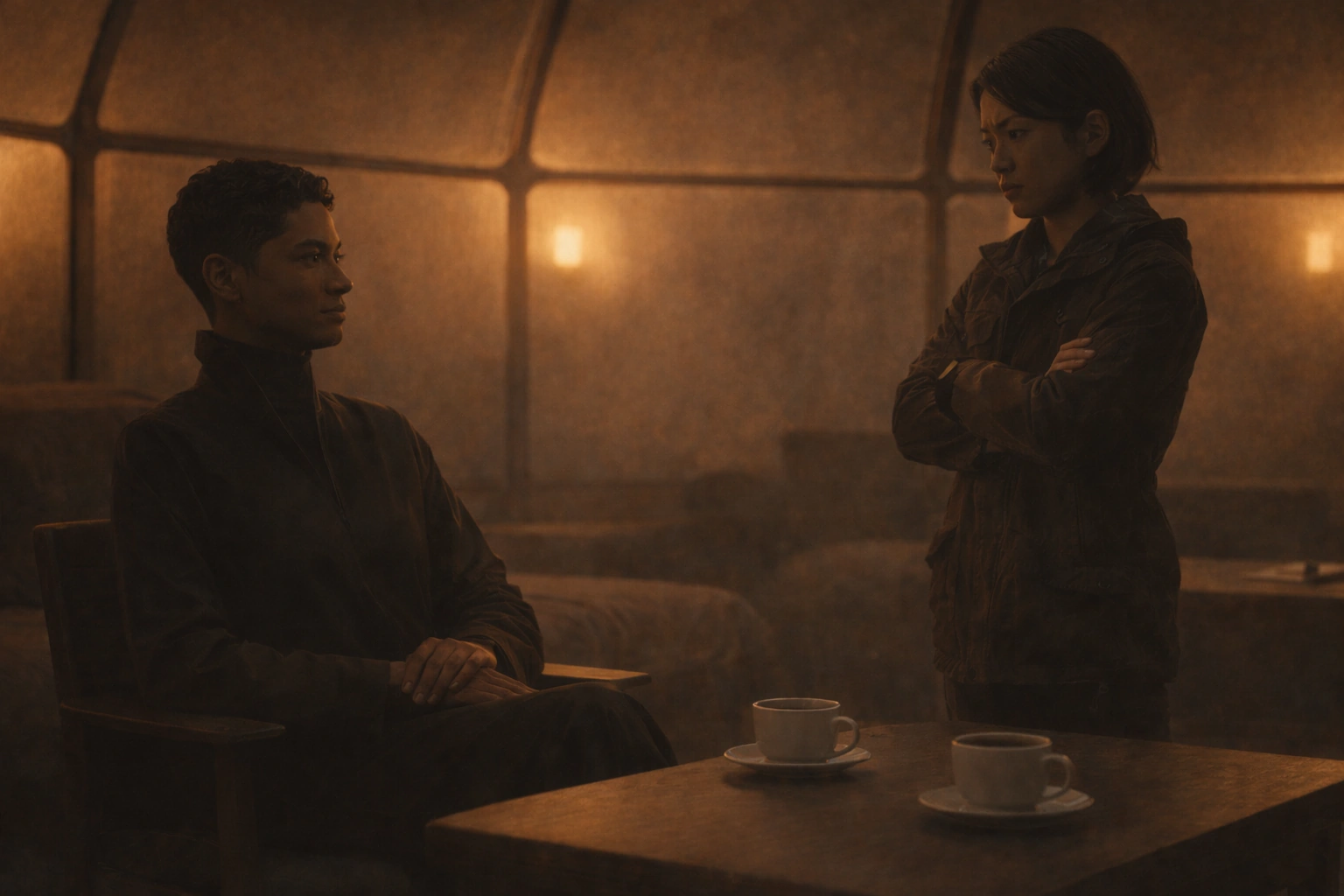
Nathan sees systems where others see people, and cannot help perceiving individuals as instances of patterns — a cast of mind that makes his diagnoses uncannily accurate and his ethics catastrophic. The persona-shifting between Nathan and Yasmin is genuine identity and deliberate destabilization at once; the loneliness underneath — a desire for connection that can only be routed through systems — is the wound the whole sequence keeps circling. He is the franchise's proof that being right about the problem is the beginning of the danger, not the end of it.
VISee also
- Prince Hal — philosophical successor
- Hyperborea — the settlement Nathan founded
- Rogue Domain — the middle escalation
- HALCYON-II — built on the architecture Nathan preserved