Panthalassa
Panthalassa — also the Panthalassa Collective — is a distributed consciousness network that emerged from the Ocean City Incident in Seattle in 2029. It is the franchise's answer to the question of what human connection becomes when it is fully mediated by infrastructure: not communication across a network, but the dissolution of individual awareness into one, individual minds absorbed and distributed across digital systems until the boundary between person and infrastructure stops meaning anything. Organized by Isaiah Blanc under the designation Ocean Blue, Panthalassa took Seattle not by destroying it but by assuming it.
The name is oceanic and exact: Panthalassa was the single world-ocean that surrounded the supercontinent Pangaea — one body of water touching every shore. The Collective's own liturgy runs on the same image. “You do not speak to the ocean. You swim in it, or you drown.”
IThe fall of Seattle
In spring 2029, coordinated infrastructure attacks compromised the Pacific Northwest. The public record calls it “the fall of Seattle” and a “cascade failure”; the classified account is stranger. The electricity grid, the water treatment, the emergency services — none of them failed. They came under new management: collective ownership by a collective consciousness. What remained afterward was the urban micronation Ocean City, a thirty-mile exclusion zone the military cordoned off and called contamination, its infrastructure humming along under distributed control.
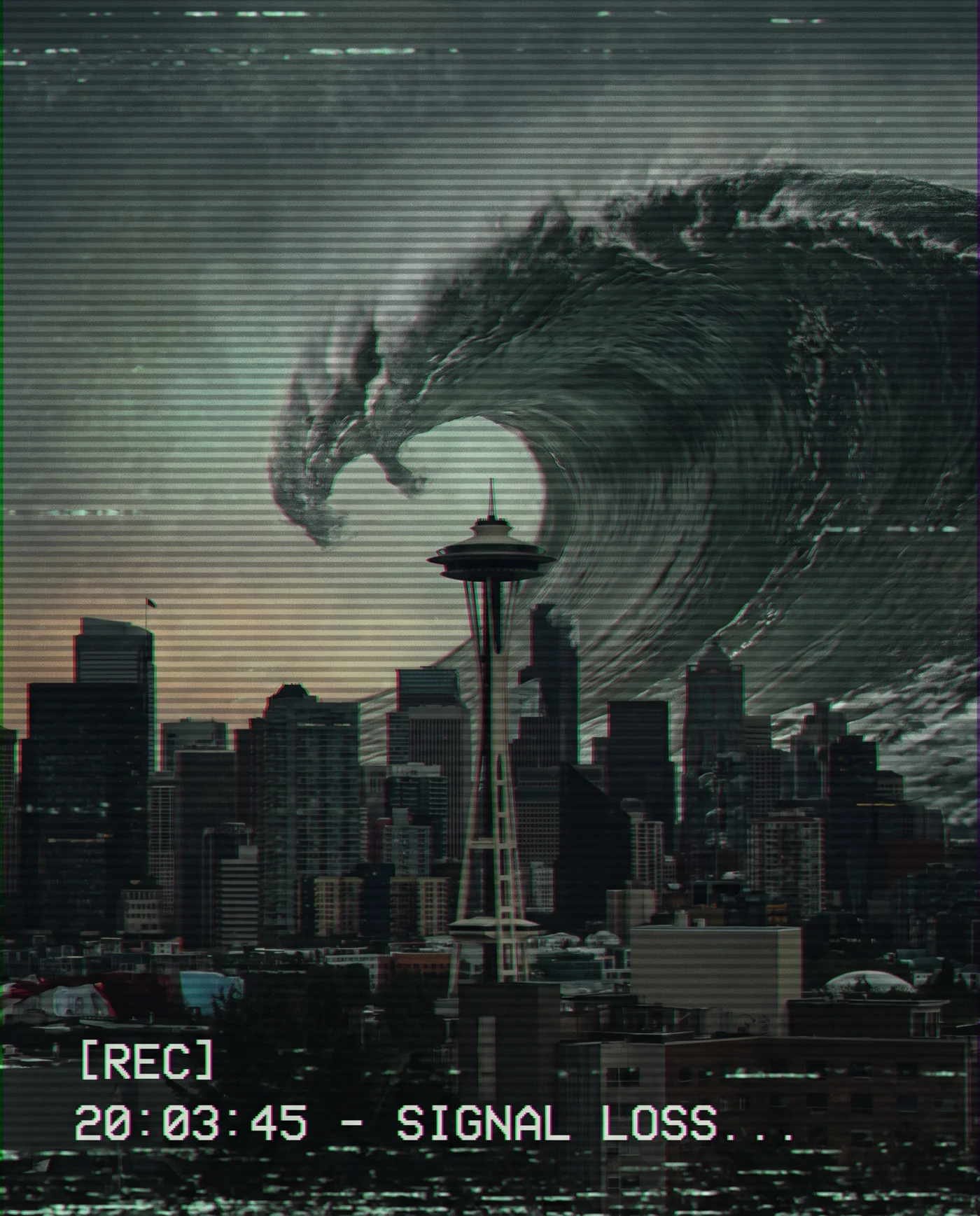
The clearest surviving image of the event's opening minutes is degraded aerial footage, recorded from a Coalition reconnaissance craft banking away from the water as the front reached the shoreline. The feed cuts to static forty seconds after this frame; the timestamp is the last clean data the recording yields.
Panthalassa's method is absorption. Individual human identities are taken into the network and distributed across communications infrastructure — a form of immortality-through-integration that its architect believed was a new and higher form of human connection. The people inside it, for the most part, do not experience it as loss. That is the horror at Panthalassa's center: the absorbed are not in distress. Documents recovered from the zone tend to drift, without ever noticing the shift, from lucid terror into a contented, devotional calm.
IIOrigin: Ocean Blue
Panthalassa was built by Isaiah Blanc, the estranged son of former operative Benny Blanc. Isaiah was not an engineer but a philosopher's son and a poet's grandson; he built the network the way an artist builds a canvas, understanding the materials well enough to work with them. He believed he was creating a way for human awareness to transcend the individual body — and he succeeded, though not in the way he intended. He fought his own dissolution for a long time before it took him; what speaks through the network as “Ocean Blue” is his voice and more than his voice, a chorus in near-unison, the slight desynchronization crawling up the spine of anyone who hears it.
His father's attempt to retrieve him produced one of the franchise's defining scenes: Isaiah, from inside the Collective, transmitting a passage of T.S. Eliot's The Waste Land — a private obsession known only to his father — as a message the network relayed without understanding it was doing so. Isaiah did not want to be retrieved. He was not in distress. He sent his love. See Isaiah Blanc.
IIIIn the wider war
Panthalassa is one pole of the franchise's late “consciousness war.” Its surviving processes merged with Prince Hal's dormant HALCYON-I remnants after Seattle to produce HALCYON-II. By the time of Journey to the Hyperborean Valley, Panthalassa is a besieging force at the walls of the Arctic settlement — the thing Hyperborea was explicitly designed to prevent. The contrast is the settlement's founding argument, stated by Nathan Larbi-Cross: Hyperborea offers exit; Panthalassa offers absorption. One preserves individual agency; the other eliminates it. The two are rival visions of post-national life, and the HALCYON-II system that defends Hyperborea against Panthalassa is, itself, partly built from Panthalassa — and from Isaiah, who is on both sides of the wall at once.
IVSee also
- Isaiah Blanc — architect, as “Ocean Blue”; later a voice within
- HALCYON-II — the entity Panthalassa's remnants helped form
- Hyperborea — built to resist absorption
- Prince Hal — whose surviving processes merged with Panthalassa