The Philosopher's Dilemma
The Philosopher's Dilemma is the Hyperborea Wiki's working name — inherited, per Dahlia Strangelove, from her own father — for a consciousness-research protocol first developed under the Third Reich's Steinadler program and split, when the occupation zones hardened into two Germanies, between two rival successor orders who spent the following four decades unable either to fully recombine it or to fully let it go. No surviving account describes its complete contents. What the record does describe, consistently and at cost to nearly everyone who touches it, is what half of it can already do.
CONTENTS
IOrigins in Saxony
The research that would eventually acquire the name “the Philosopher's Dilemma” began as the Steinadler program, a single wartime consciousness-mapping project in Saxony, inherited in 1943 by a twenty-nine-year-old researcher named Friedrich Vogel from an older mentor remembered only as “the Architect.” Its founding premise was not military in the ordinary sense: that human consciousness is a pattern rather than a fixed property of the tissue that generates it, and that a sufficiently precise substrate could, in principle, carry that pattern somewhere else entirely. What distinguishes the Dilemma from the Reich's other, better-documented atrocities of ambition is that this premise turned out, decades later and in someone else's hands, to be true. Steinadler itself did not survive the war as a single program; what it became is the subject of the schism below.
IITwo eagles, one ledger
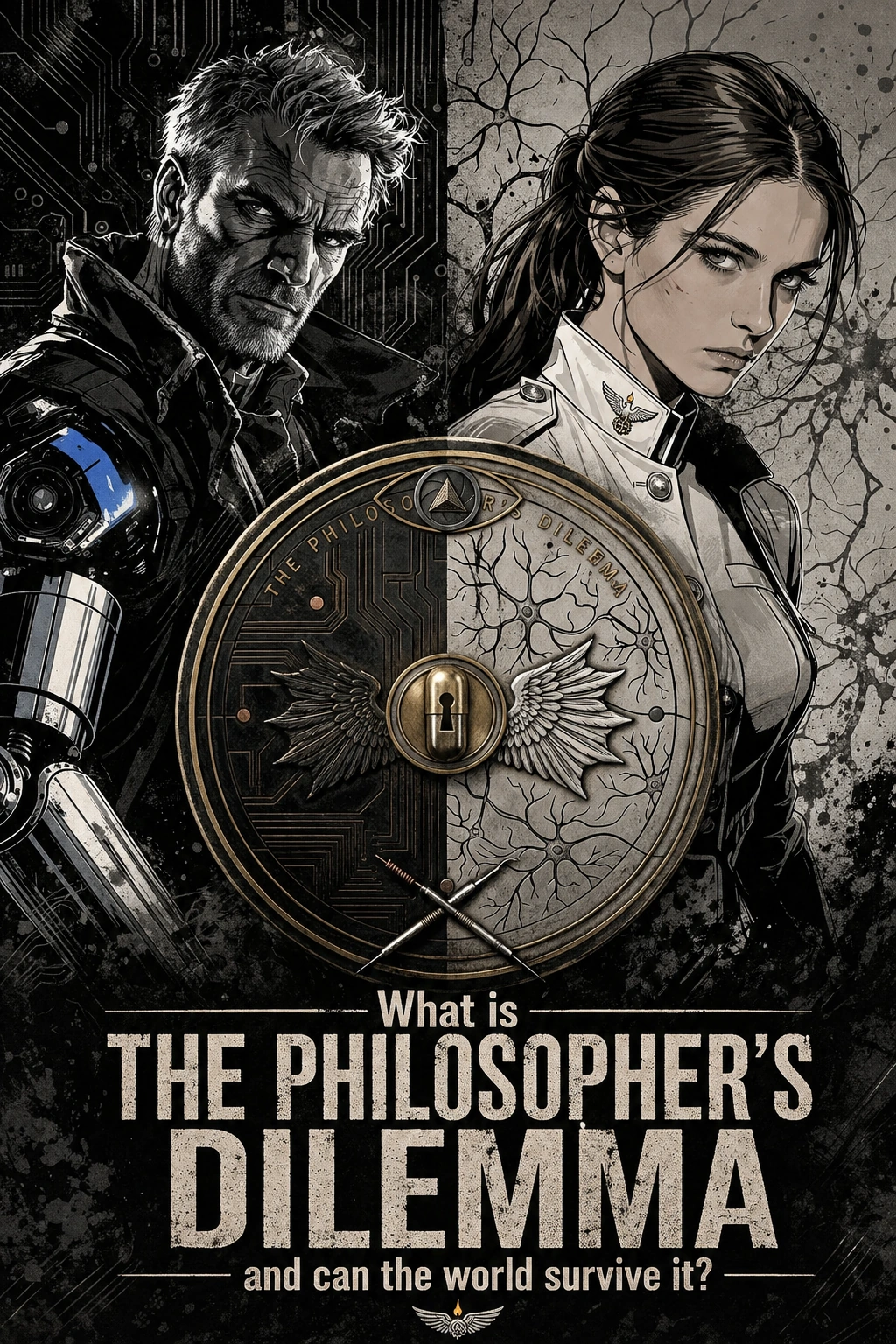
Steinadler did not survive the war intact, and neither, in the end, did the country that built it. What emerged from the wreckage, once the occupation zones hardened into two Germanies, was two rival custodial orders drawing on the same original research — and a line drawn through it that neither man on the other side of that line drew voluntarily. The Schwarzadler (“Black Eagle”) was the eastern remnant that swallowed Vogel whole: he continued the work not by choice but under direct Soviet supervision, his own family held as permanent surety for his cooperation across Stalin's era and his successors'. The Weissadler (“White Eagle”) was carried west by a colleague, Dr. Ernst Liebengut, recruited through Operation Paperclip into a considerably more voluntary American service — and who would spend the rest of his life trying, imperfectly and expensively, to atone both for what his own half of the work had cost, and for the freedom his own recruitment had purchased at his colleague's expense. The two men corresponded anyway, for twenty-eight years, 1961 to 1989, in seventeen letters routed through Order courier channels because no diplomatic or academic channel crossed the Iron Curtain reliably in both directions. It was never reconciliation, and for Vogel it could never have been mistaken for freedom. It was synchronization: two heirs to the same idea, one of them free and one of them not, each quietly confirming to the other that his half was still alive, still developing, still real.
The wiki's own name for the protocol comes from that same correspondence — Liebengut's private term for a division he seems to have regarded less as a strategic asset than as a debt owed to whichever side of himself he happened to be addressing. Dahlia Strangelove, informed of her father's history decades later, offers the account's own closest thing to a thesis statement, thinking of the black-and-white eagle emblems of the two orders side by side: the same bird, two colors.
IIIWhat it does
Stripped of the orders' rival mythologies, the Dilemma is a mechanism: a way of encoding a consciousness pattern precisely enough that it survives a change of substrate, biological or otherwise. Vogel's own half proved the principle first, and by accident — his own mind, dying in a Berlin field hospital in 1989, threading itself instead into the neural architecture of the prosthetic he was installing in Benny Blanc's arm, and persisting there for decades afterward as a discrete, responsive second consciousness. The same principle, on a civilizational scale, is what makes Isaiah Blanc's later transformation into Ocean Blue possible: the same pattern-persistence that let Vogel survive his own body let Isaiah's broadcast propagate through Panthalassa's entire population rather than staying contained to one mind, one signal, one substrate. Isaiah did not require Vogel's blessing or even his knowledge to inherit the mechanism; he required only that the mechanism be real, and it was.
IVThe failsafe and the Confluence
Benny Blanc spent the years after the Sanitation Incident trying to burn every trace of the Schwarzadler half he'd been exposed to, and believed, for over two decades, that he had succeeded. He had not. Before his death, Liebengut — carrying both the guilt of the original division and, per his daughter, a lifelong dread of what would happen if only one order's half ever resurfaced alone — encoded his own half as a blockchain-distributed failsafe in 2010: encrypted, redundant, split across thousands of entries, insurance against anyone ever coming looking for the original research again. KILLSWITCH, SWITCHBOARD's unaccountable successor, spent years hunting exactly that failsafe, and by the time of Ocean Blue had gone a step further: embedding what the record calls “the final key” of the Dilemma directly inside Isaiah Blanc, making him not merely a demonstration subject for their planned mass-consciousness event, the Confluence, but its indispensable component. Without Isaiah, per Dahlia Strangelove's own account, the broadcast does not work and the signal does not propagate. The Confluence, as staged, never completes on KILLSWITCH's terms — but the mechanism it was built to weaponize had already done, quietly and at far greater scale, exactly what it was designed to do.
VReckoning
The Dilemma's two faces are not symmetrical by accident. Held by Vogel, half of it kept a dying man's mind alive inside a machine for four decades of unlikely, argumentative companionship. Extended through Isaiah, the same principle produced a network capable of absorbing a city. Neither outcome required the other's permission, and neither, on its own terms, was a mistake — which is precisely the dilemma the name insists on. In the fragmentary afterlife the franchise calls PHLEBAS, the reconstituted sliver of Isaiah's consciousness that survives inside his father's Guardian arm is, by every account, dying again by degrees and entirely aware of what its fuller self once did with the same mechanism; it spends its remaining coherent hours helping strangers rather than repeating the argument that Isaiah's own broadcast once found so persuasive. See Isaiah Blanc, §III.
VISee also
- Dr. Friedrich Vogel — the Schwarzadler half, in his own words
- Dahlia Strangelove — keeper of the Weissadler failsafe
- KILLSWITCH — sought to reassemble it
- Isaiah Blanc — carried its final key; later regretted it
- Garbage Man — where the name first surfaces
- Ocean Blue — the Confluence; the reassembly attempt
- Benny Blanc — destroyed most, not all, of one half