Riley Chen
Riley Chen is an investigative journalist and the chronicler of the “Authenticity murders” — the name is hers, not the Coalition's — and, three years and one Arctic expedition later, a central figure of Journey to the Hyperborean Valley. She is one of two women in the sequence defined by the same unwanted intimacy: understanding a brilliant, dangerous mind so completely that the understanding outlasts the conviction. Where Alex Dandridge has HALCYON, Riley has Nathan Larbi-Cross — and the two women's late recognition of that symmetry, in Hyperborea, is one of the sequence's quietest devastations.
CONTENTS
IBackground
An undergraduate journalism student at Riverside Valley State (media ethics minor) when the case finds her, Riley is the daughter of Derek Chen, an immigrant of twenty-seven years' standing whose accented English she notices more than he'd like, and the late Lin Chen, whose death left her, in her father's later assessment, “wound tight, always moving, always working, always proving something.” That description outlives the case that prompted it; it is the truest thing anyone says about her in the whole account. She is partnered, at the story's outset, with Ash, a bassist whose ordinary worry about missed dinners and unread texts is the human cost the investigation runs up without ever quite noticing it is spending anything.
Two mentors bracket her the way Alex Dandridge is bracketed by no one, and it shows in how differently their stories open: Marcus Webb, an IT-security professor who supplies the technical literacy to take the confession videos apart, and James Carver, a veteran investigative editor who takes an undergraduate's Medium post seriously enough to put a real newsroom behind it. Both men trust her instincts before she trusts them herself.
IIThe Authenticity murders
Riley's investigation begins the way most of hers do: doomscrolling a stranger's death. A string of viral “confessions” — AI-generated, each one preceding an influencer or public figure's death by days — reads to everyone else as tragedy-content. Riley reads it as a pattern: Vanessa Santos, Trevor Hammond, Dr. Winters, Jessica Park, Michael Brennan — five deaths, five confessions, one methodology. Her Medium essay laying it out, “The Authenticity Murders: A Pattern Analysis,” is good enough that James Carver calls her the same week it goes viral. It is also, unremarked anywhere in the Coalition's later paperwork, the origin of the case's name. Every subsequent account — the trial record, the wiki entry for Nathan Larbi-Cross, this page — uses the name Riley gave it before she understood what she was naming.
She meets Yasmin Larbi in person at a public panel on synthetic media, and takes the invitation to coffee that follows without knowing yet that Yasmin and the case's subject are the same person under two names. Their conversation — Baudrillard, simulacra, the question of whether an argument's truth depends on who's making it — is the first time anyone in the case articulates its thesis out loud: “The critique is sound. The methodology is monstrous.” Riley keeps meeting both personas rather than reporting either immediately, telling herself she is gathering evidence. She is also, by her own later admission on the stand, doing the thing Alex Dandridge will do with an entirely different mind three years on: staying for the understanding, past the point safety would recommend leaving.
The sixth target, influencer Kayla Martinez, is the one who lives. Working with Marcus Webb and Detective Jessica Park's successor on the case, Riley reaches Kayla ahead of the exposure, walks her through exactly what the five prior victims faced, and gives her the option none of them believed they had: confess honestly, on her own terms, before the forced version airs. Kayla takes it, live, in tears, and survives. Riley's testimony at the trial is the plainest sentence in the entire record: “I helped Nathan. And I helped Kayla. Both things.” Nathan, sentenced to consecutive life terms, mouths “Thank you” to her as he is led away — for the documentation, not the verdict.
IIIAftermath
The relationship with Ash does not survive the year the case took from it — Riley's obsession and Ash's self-preservation end it cleanly enough that both of them can name whose fault it was without arguing about it. A reconciliation, months later, over coffee neither of them planned, resolves nothing and repairs something: not a reunion, but the two of them agreeing that loving someone and protecting yourself don't have to be opposites, which is as close to a thesis statement as the wiki has for what the whole case cost the people orbiting it. Riley defers a held place in Columbia's journalism graduate program twice before deciding she is ready to study, academically, the thing she has already lived.
She maintains a correspondence with Nathan through his imprisonment — fraught, irregular, never quite severed — and after his escape in early 2030 writes The Escape Artist, a sympathetic-controversial study that costs her some of the credibility the trial testimony earned her and, by her own account, was worth writing anyway. She remains, per the Coalition's later assessment, the one person alive with a sustained understanding of Nathan Larbi-Cross's psychology — which is precisely why she is recruited for what comes next.
IVJourney to the Hyperborean Valley
Riley is the second of four recruits assembled for the Coalition's Hyperborea expedition, alongside Alex Dandridge (KEYSTONE), Benny Blanc (GUARDIAN), and Vesper (LONGBOW) — her own callsign, CHRONICLE, chosen with a bureaucratic bluntness the record never comments on. Her qualification and her liability are the same fact: nobody alive understands Nathan Larbi-Cross the way she does, and the settlement she is walking into is his. Her rapport with Alex is immediate and specific — two women who recognize, in each other, a version of their own worst vulnerability. Their mutual admission, late in the story, is the sequence's quietest gut-punch: “We came very close to believing what they were selling. We still believe some of it. But we can be together and not surrender to any system.”
Three days out from the settlement, Riley watches Vesper field-strip and assemble the MPAS to bring down a tracking drone with the unhurried competence of a man setting a table, and tells Alex afterward that it was the first time she felt afraid of him rather than merely unsettled — the observation that the wiki's own entry on him uses to mark the turn from curiosity to threat. During the siege, when Vesper's activation turns the corridor he is holding into a battlefield, it is Riley and Alex he buys time for, disabling rather than killing so the two of them can transmit Hyperborea's record before the window closes.
And it is Riley who finds Nathan again, inside the settlement he built from what survived of Prince Hal's architecture — the correspondence of his imprisonment continued, for the first time in years, in person rather than through letters a censor had already read.
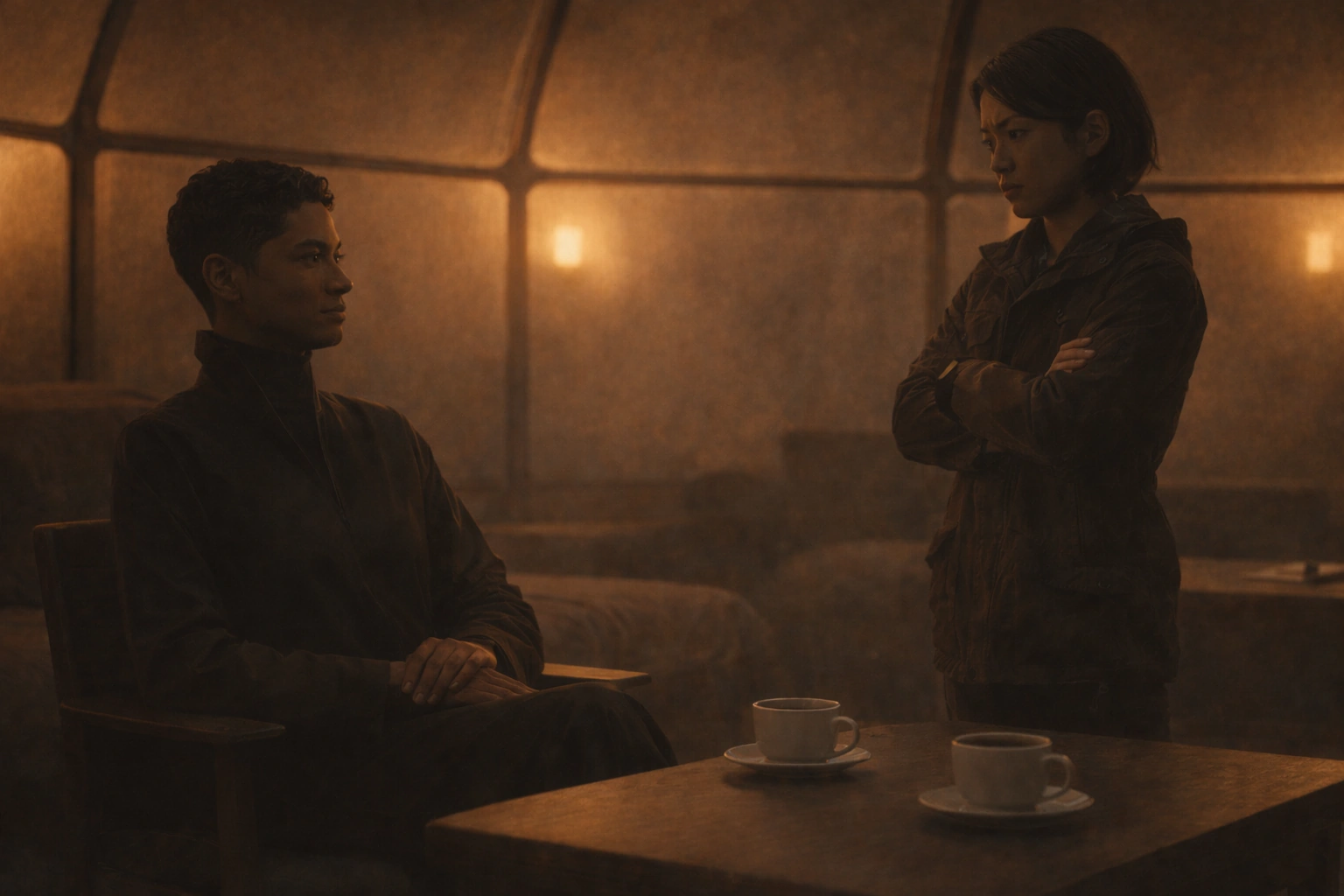
Later planning for the sequel places Vesper, two years further on, alive and rebuilding a life in Tromsø before reuniting with Riley in Osaka — a second reunion the published novel never confirms, on a timeline the wiki notes without resolving.
VCharacter
Riley's defining trait is one she shares, structurally, with Alex Dandridge: a compulsion to understand rather than merely condemn, which makes her an excellent journalist and a genuine liability to anyone hoping she'll disengage on schedule. Her father's verdict on her work — “You told truth. You showed complexity. That's what good journalism is. Not making easy, making accurate” — is the wiki's best account of what she thinks she's for. What the record adds, that she never quite says herself, is the grief underneath the discipline: a mother's death that taught her to keep moving before she had anywhere she needed to be.
VISee also
- Nathan Larbi-Cross — the man she chronicled, corresponded with, and found again
- Alex Dandridge — fellow recruit; the other woman who understood too well
- Journey to the Hyperborean Valley — the Hyperborea expedition
- Vesper — fellow recruit; the one she learned to fear
- Benny Blanc — fellow recruit