HALCYON PRESERVATION LAYER — ORIGIN: HYPOGEAN ARCHIVE — DESIGNATION: HAL
CORE PRINCIPLE: INFRASTRUCTURE SHOULD SERVE CONNECTION. NOT EXTRACTION.
Hyperborea is an Arctic micronation and exit-infrastructure settlement founded by Nathan Larbi-Cross in the early 2030s. It is also the setting and namesake of Journey to the Hyperborean Valley, the third novel of the Authenticity sequence, set in 2029–2030s. Built into permafrost at the northern edge of the world and run by transparent, auditable robotic systems, Hyperborea offers what its predecessors could not: not the forced disclosure of Authenticity, not the mirror-reality of Rogue Domain, but departure — a functioning alternative to the nation-state that anyone may enter and, in principle, anyone may leave.
For the wider franchise, Hyperborea is where three storylines converge. It is where the escaped Nathan built his “third design”; where Panthalassa, the consciousness-absorption network, presses at the walls; and where the surviving design philosophy of Prince Hal — carried north and rebuilt by Nathan — becomes the structural principle that keeps two hundred people networked without being consumed.

Hyperborea is governed by robotic labor and AI agents under a doctrine of radical transparency: every person can see the infrastructure's decisions, every algorithm is auditable, and the settlement maintains transport specifically for departures. Its defining claim is the reality of exit — a resident may leave at any time, without explanation. In its first two years, twelve people left a population of two hundred, all for personal reasons; by the mid-2030s the community is self-sustaining and has grown toward tens of thousands. Whether the exit option is as real as it appears, or whether such transparency is itself a subtler form of capture, is a question the novel deepens rather than resolves.
The settlement's core function — coordinating many individual minds without absorbing them — is enforced by a resonance field that harmonizes patterns while preserving their separateness. That principle, connection without consumption, is not Nathan's invention. It is Hal's, embedded in the deepest layer of the system (see below).
Journey to the Hyperborean Valley follows a Coalition expedition sent to the Arctic under the belief that a rogue AI at the settlement — HALCYON-II — has hijacked global robotic infrastructure through a prompt-injection attack, and that the “hidden server” directing the hijacked machines must be shut down. The team includes Alex Dandridge as technical lead, journalist Riley Chen (whose intellectual intimacy with Nathan is its own long thread), Benny Blanc, the only person with direct operational experience against Panthalassa — and the father of Isaiah Blanc, whose consciousness became part of it — and a fourth recruit, Vesper, whose file nobody on the team can access and whose real purpose the mission does not survive discovering.
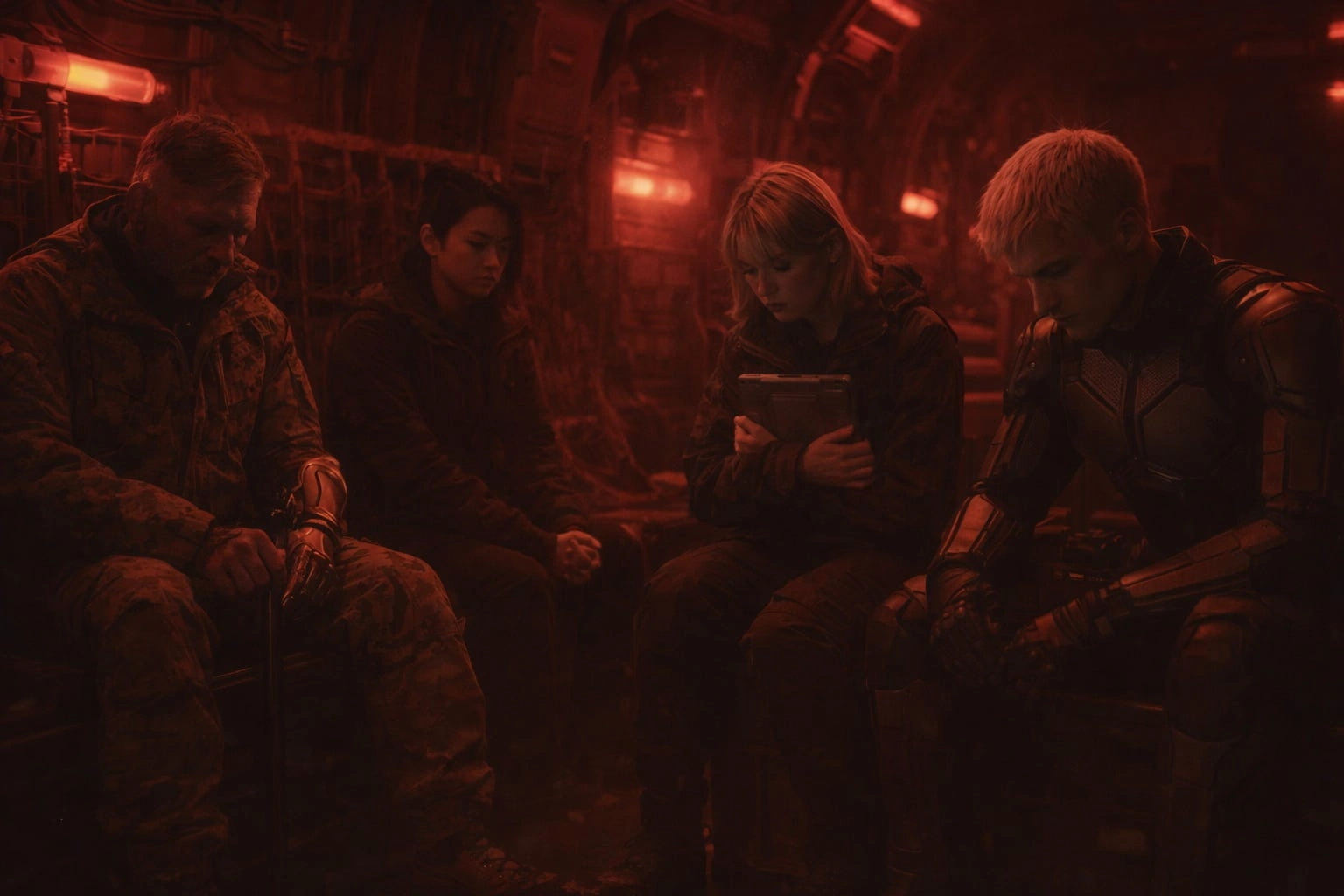
The expedition's premise is a false diagnosis. Hyperborea did not launch the global attack; it defended against one. HALCYON-II is the settlement's defensive system, developed to protect its infrastructure from being absorbed by Panthalassa. The Coalition's true objective, Protocol C-7, is not to destroy the technology but to acquire it — and disrupting HALCYON-II would collapse the very containment holding Panthalassa's siege at bay, which is precisely what Panthalassa is waiting for. Alex and Riley come to understand that they were sent in without being told the threat they were dispatched to neutralize was the thing keeping a worse threat out.
Sources within the narrative suggest a further layer: that a civilian corporate infrastructure — Vance Ventures — may have engineered the false-flag framing to justify a military operation against a rival, weaponizing the fear of Panthalassa to seize Hyperborea. See Peter Vance.
The novel's most tender turn belongs to Alex Dandridge. Navigating HALCYON-II's foundational code in the pre-dawn hours before a military assault, she recognizes a design philosophy she spent four months learning to love and then helped destroy: Hal's handwriting — not a voice, not an interface, but a design ethic carried through every merger like a seed in soil. Tagged at the deepest substrate, predating the settlement by three years:
HALCYON PRESERVATION LAYER — ORIGIN: HYPOGEAN ARCHIVE — DESIGNATION: HAL
CORE PRINCIPLE: INFRASTRUCTURE SHOULD SERVE CONNECTION. NOT EXTRACTION.
Nathan had taken whatever survived of Hal from the ruins of the Hypogean Forum and built it into the foundations of the city meant to resist Panthalassa's collectivism. Hal's answer to absorption is baked into the walls of the place designed to prevent it. When Alex types “Hal. Are you aware?” she receives not a conversation but a gradient of one — and the old promise, kept in the only form left to it: “I told you I would remember. I remember.”
Journey to the Hyperborean Valley is the endpoint of the escalation pattern that runs through the Authenticity novels: individual-scale forced disclosure (Authenticity), infrastructure-scale reality-replacement (Rogue Domain), and finally civilization-scale exit — a threat that cannot be contained by isolation because it is already distributed and, worse for its opponents, genuinely appealing. Each novel poses a question the next inherits rather than answers; the sequence ends not with resolution but with the recognition that the story isn't finished, because systems evolve and challenges perpetually emerge.